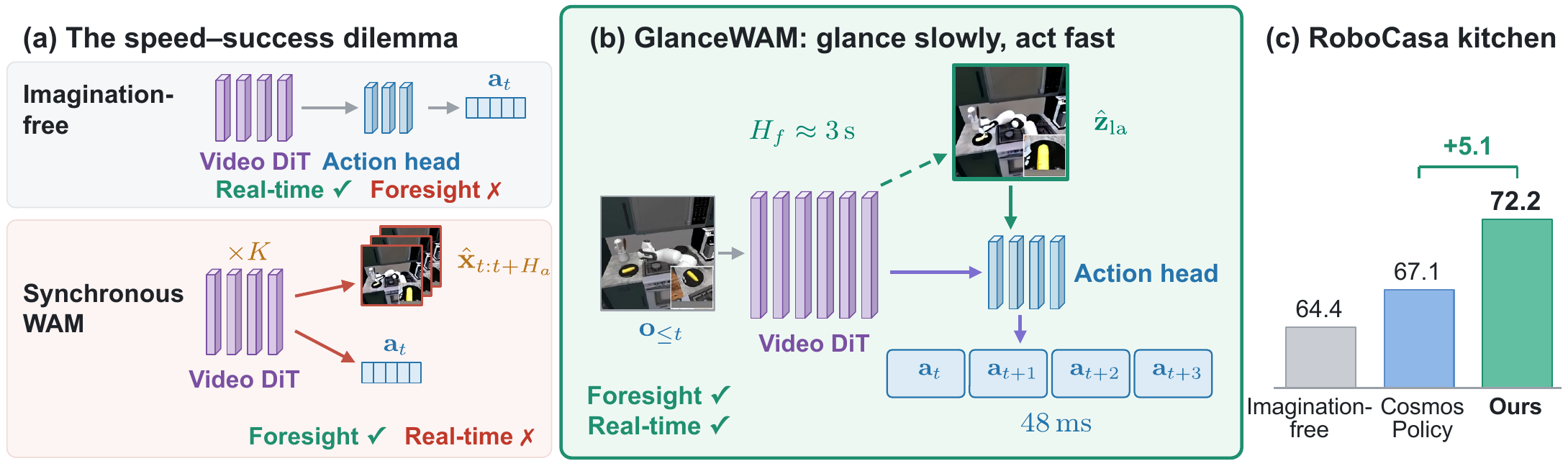
Glance slowly, act fast. GlanceWAM keeps test-time visual imagination but moves it off the control path: a video DiT imagines one lookahead frame seconds ahead in the background, and the action head acts on it in latent space at control rate.
Real-Robot Rollouts
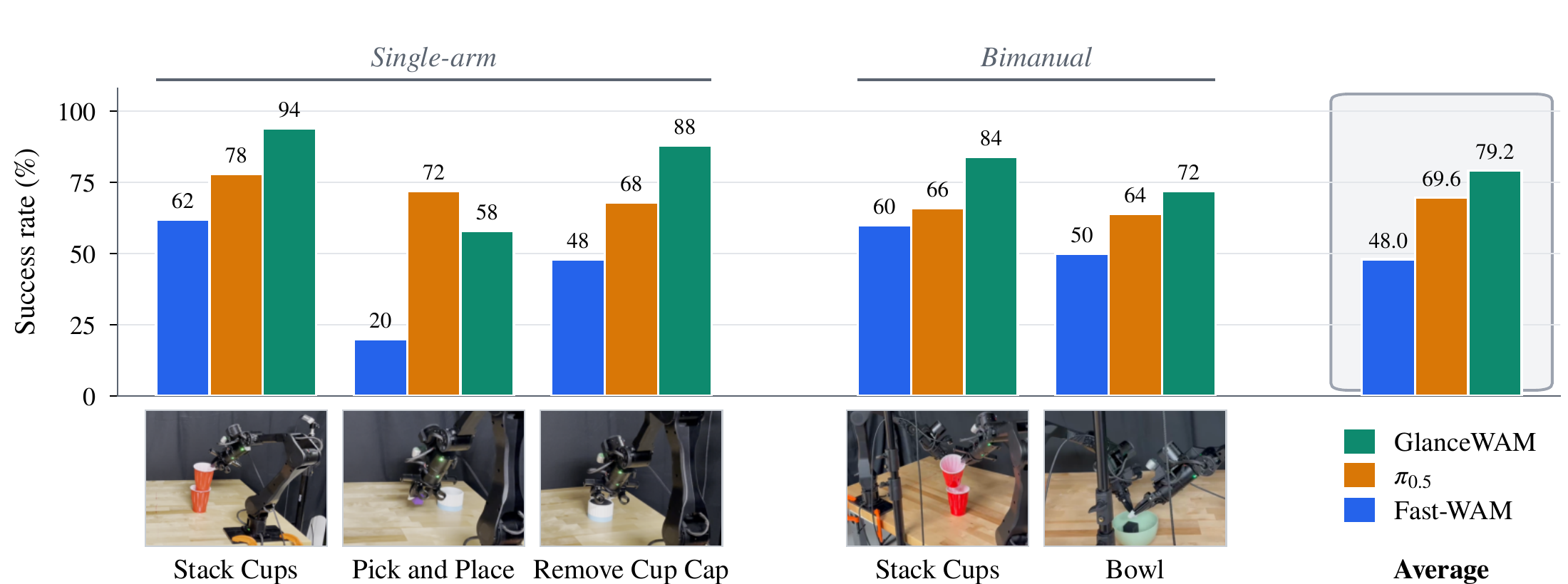
GlanceWAM on the IMETA Y1 platform, trained on 50 teleoperated demonstrations per task. Success rates are over 50 trials per task (GlanceWAM vs. π0.5).
Continuous, uncut sessions. Robot rollouts are shown at 4×, human scene resets at 8×; people are masked out.
Abstract
Video generative models provide rich physical priors for robot learning, yet existing world-action models (WAMs) face a fundamental trade-off: synchronous video generation at control rate is latency-prohibitive, while abandoning test-time visual imagination sacrifices task success. We show that visual imagination achieves both real-time inference and superior success rates when generated asynchronously off the critical path and consumed directly in latent space. We introduce GlanceWAM, which decouples imagination from control on a single shared video DiT backbone: an asynchronous proposer glances ahead on a slow clock to imagine a single lookahead frame seconds into the future in the background, while an action head decodes action chunks at control rate (48 ms) purely in latent space without blocking. Enabled by a non-interfering attention mask that isolates video representations and staleness-robust horizon training that accommodates asynchronous lookahead aging, GlanceWAM breaks the speed–success dilemma. Trained purely on demonstrations, it attains 72.2% on the 24-task RoboCasa kitchen benchmark (vs. 67.1% for synchronous Cosmos Policy) and 99.0% on LIBERO while cutting per-chunk control latency 24× relative to synchronous world-action models (48 ms on one A100). In single-arm and bimanual real-robot manipulation, it achieves higher average success than π0.5 without any robot-data pretraining.
Method
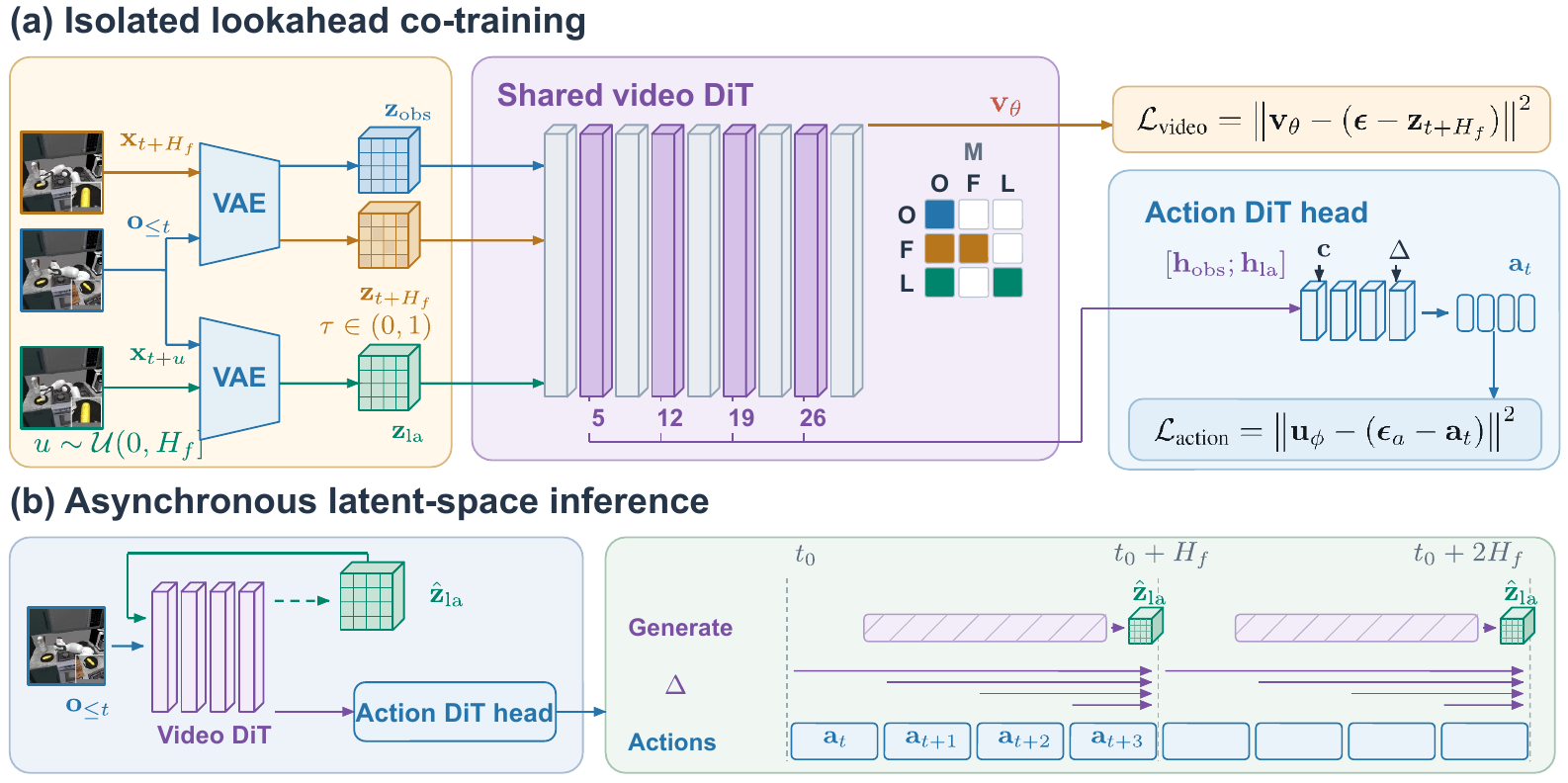
Asynchronous latent lookahead
The video DiT imagines one frame about 3 s ahead on a slow background clock. The action head decodes 0.8 s action chunks against it in a single 48 ms pass, with no VAE decoding in the loop.
Non-interfering attention mask
A prefix-LM mask keeps lookahead tokens from contaminating observation encodings. Retraining without it (bidirectional attention) drops RoboCasa success from 71.5% to 47.0%.
Staleness-robust horizon training
The policy is supervised on lookaheads at random offsets u ~ U(0, Hf], so it stays accurate as a held lookahead ages between refreshes.
Results
24 tasks, 50 demos/task
4-suite average
24× lower latency than synchronous WAMs
vs. 69.6% for π0.5
RoboCasa kitchen
| Model | SR (%) | Demos/task |
|---|---|---|
| π0 | 62.5 | 300 |
| Video Policy | 66.0 | 300 |
| GR00T-N1.5 + HAMLET | 66.4 | 300 |
| FLARE | 66.4 | 300 |
| Cosmos Policy | 67.1 | 50 |
| GlanceWAM (ours) | 72.2 | 50 |
Held-out scenes, 1,200 episodes. Selected rows; the full table is in the paper.
The lookahead is load-bearing
| System (RoboCasa kitchen) | SR (%) |
|---|---|
| Plain co-training (no lookahead) | 64.4 |
| GlanceWAM, single-layer lookahead | 71.5 |
| same checkpoint, lookahead zeroed | 61.6 |
| retrained without mask | 47.0 |
| GlanceWAM, multi-layer (final) | 72.2 |
Zeroing the lookahead at test time drops success below the no-lookahead baseline: the policy relies on it. One sampler step for the lookahead (71.2%) performs on par with ten (71.5%).
Real-robot evaluation
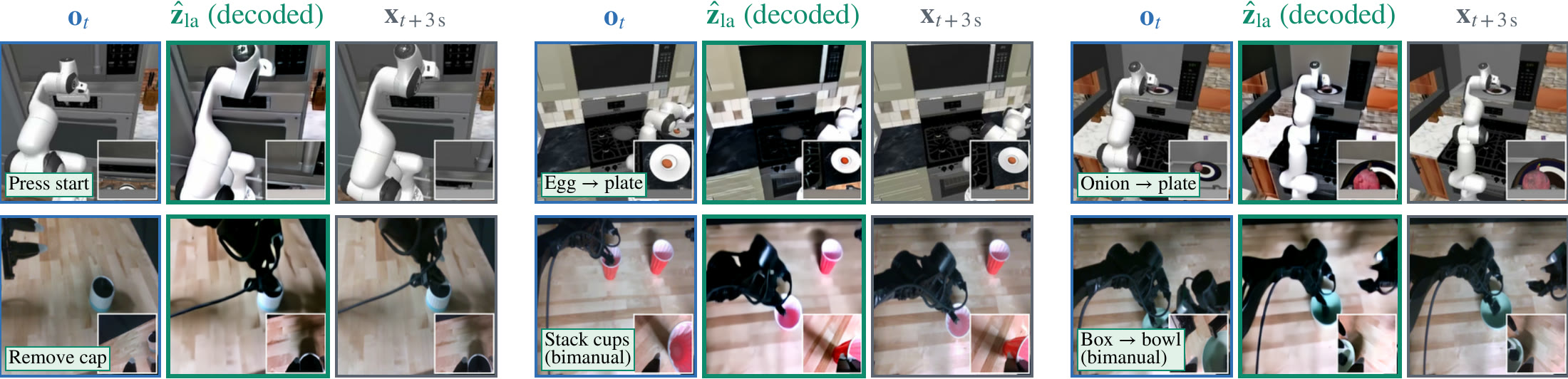
What the model imagines
BibTeX
@article{wang2026glancewam,
  title         = {GlanceWAM: Sparse Test-Time Imagination for World-Action Models},
  author        = {Wang, Linhan and An, Zijian and Zhang, Mingyuan and Dai, Chen and Xu, Yi and
                   Cui, Can and Wang, Jiayan and Yang, Zichong and Chen, Yinlin and Zhou, Lifeng and
                   Lu, Chang-Tien},
  journal       = {arXiv preprint arXiv:2608.23927},
  eprint        = {2608.23927},
  archivePrefix = {arXiv},
  url           = {https://arxiv.org/abs/2608.23927},
  year          = {2026}
}